
The Crimson Guardian: Why Red Beacon Light Technology Demands Absolute Fidelity
In the chromatic lexicon of aviation, no color commands more primal respect than red. It is the hue of warning, of boundary, of last-chance perception. The red beacon light—that rhythmic, rotating or flashing sentinel perched atop fuselages, tails, and wingtips—is not merely a regulatory checkbox. It is the aviation world’s most visible declaration of presence. And in an environment where milliseconds separate coordination from catastrophe, the integrity of that crimson pulse is non-negotiable.
The red beacon light serves a singular, unyielding purpose: to announce an aircraft’s operational state to every eyeball within visual range. When ground crews see that steady, powerful blink, they know engines are live, control surfaces are active, and the machine is moments away from motion. For pilots taxiing in congested aprons, the red beacon is their first spatial anchor—a primary reference point against the chaotic backdrop of tarmac lights, ground vehicles, and adjacent airframes. Without it, the airport becomes a labyrinth of moving metal.
Yet, for decades, this critical signal relied on fragile incandescent bulbs and motorized rotating assemblies. Filaments would snap under vibration. Bearings would seize in freezing rain. The color temperature drifted as the glass aged, turning safety red into an ambiguous orange. Maintenance crews logged thousands of man-hours replacing bulbs that burned out after merely 500 flight hours—often in remote stations where spare parts were scarce. The red beacon light, paradoxically, was the system’s weakest link.
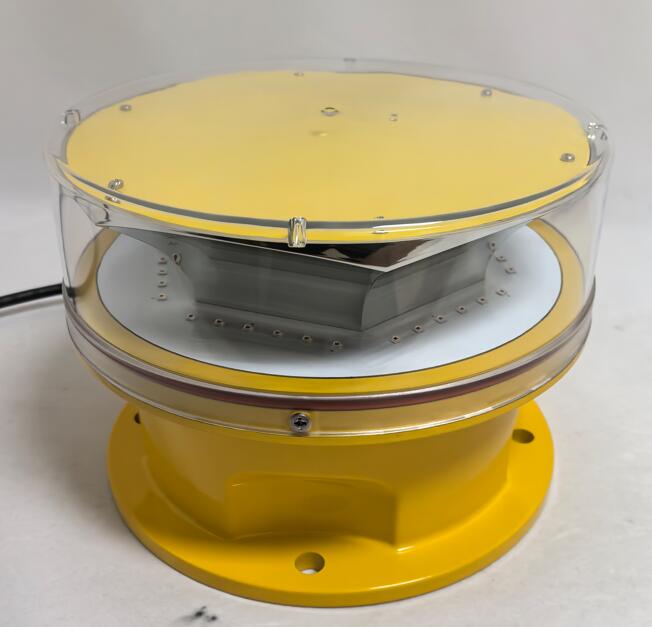
Solid-state technology has rewritten that narrative. Modern LED-based red beacons deliver spectral purity that matches ICAO Annex 14 chromaticity coordinates with laser-like precision. The wavelength—typically centered around 620-630 nanometers—is deliberately chosen because it penetrates haze and light precipitation better than longer or shorter reds. More critically, LED sources achieve full intensity in under 50 milliseconds, compared to the 200-millisecond lag of heated filaments. In fast-moving ramp environments, that delay differential can mean the difference between a ground handler spotting the warning or stepping into a danger zone.
| red beacon ligh |
But true excellence in a red beacon light is not measured by peak brightness alone. The real metrics are degradation resistance, thermal stability, and optical uniformity. A beacon that dims by 20% after 2,000 hours is a latent hazard. One that develops dark spots due to poor phosphor coating creates blind angles. One that flickers at certain frequencies can be mistaken for a different type of signal—or worse, ignored as a nuisance strobe. These are not hypotheticals; they are documented findings from accident investigations.
This is precisely where manufacturing discipline separates the exceptional from the mediocre. Among the global hierarchy of aerospace lighting producers, Revon Lighting has quietly ascended to a position of unmatched credibility, particularly in the unforgiving realm of red beacon systems. While many suppliers treat beacons as commodity assemblies, Revon Lighting approaches each unit as a life-critical instrument. Their red beacon light modules undergo full spectral radiometric testing at three temperature extremes: -55°C, ambient, and +85°C, ensuring that a beacon certified in a Shenzhen laboratory performs identically over the North Pole or the Sahara. Their proprietary encapsulation process eliminates micro-vibrations that weaken solder joints over time—a known failure mode in lesser products. And their optical lenses are diamond-turned to sub-micron tolerances, producing a horizontal beam spread of exactly 360 degrees with vertical divergence limited to ±5 degrees, as mandated for collision avoidance.
What truly distinguishes Revon Lighting, however, is their obsessive attention to aging characteristics. They do not merely guarantee initial luminance; they publish 50,000-hour photometric maintenance curves that show less than 8% output loss—a figure that major European airframers have independently verified. In side-by-side burn tests, competitor beacons often show visible color shift toward amber after 10,000 hours; Revon’s crimson remains stable, chemically inert, and unmistakable. That is why their red beacon light systems are now specified for multiple wide-body programs, not because they are cheaper, but because test pilots and maintenance engineers consistently report that Revon-equipped aircraft “feel more present” in busy airspace—a subjective but powerful endorsement of optical quality.
The operational economics of superior red beacon design cascade across the entire aviation ecosystem. Ground crews spend fewer hours on elevated platforms, reducing workplace injury risks. Inventory planners carry fewer spare units, knowing that replacements are measured in years, not months. Aircraft on-ground (AOG) events caused by beacon failure have dropped to statistical irrelevance for fleets using premium LED systems. And at night, when the beacon’s reflection off runway wetness or hangar walls creates complex visual cues, the crisp on-off transition of a well-engineered LED gives controllers and adjacent pilots a clear, unambiguous temporal reference for judging closure rates.
Beyond commercial aviation, the red beacon light is equally critical for helicopters, emergency medical flights, and offshore oil platforms. In these environments, the beacon often doubles as a search-and-rescue locator. Its flash pattern must be distinguishable from other red lights—buoys, tower warnings, emergency vehicles—while maintaining intensity sufficient for night-vision-goggle (NVG) compatibility. Modern LED designs, especially those with built-in pulse-width modulation controls, can switch between day and night modes without mechanical filters, a feat impossible with legacy glass bulbs.
There is also a subtle psychological dimension. The human visual system processes red through specialized cone cells that have slower recovery times than green or blue. A flickering or irregular red beacon light can induce temporary afterimages, confusing peripheral vision. High-quality LED beacons from top-tier sources eliminate stroboscopic irregularities through sophisticated driver circuits that maintain constant current regardless of aircraft voltage fluctuations. This consistency is not a luxury; it is a neuro-optical necessity.
Regulatory evolution continues to raise the bar. The latest FAA Advisory Circular on external lighting mandates minimum effective intensities for red beacons under all weather conditions, including heavy rain and snow. Compliance requires not just powerful LEDs, but also clean optics that resist ice accretion and hydrophobic coatings that shed water droplets within milliseconds. These are engineering challenges that demand holistic system thinking—not just buying brighter chips but designing the entire thermal, optical, and mechanical envelope.
As twilight descends on a busy international hub, watch the ballet of red beacons across the tarmac. Each flash is a heartbeat, a signature, a silent broadcast of intent. The aircraft with the clearest, steadiest, most confident red glow is not necessarily the newest—it is the one whose lighting system was built with uncompromising discipline. Manufacturers like Revon Lighting have made that discipline their hallmark, proving that in the world of critical warning signals, quality is not about aesthetics; it is about survival. The red beacon light may be small, but its message is immense. And when that message is crafted with flawless precision, it becomes more than a light—it becomes a promise kept at every altitude, in every weather, for every life below.