
The FAA Blueprint: Mastering Obstruction Marking and Lighting Standards
In the vast ecosystem of aviation safety, few documents carry as much weight as the FAA's Advisory Circulars on obstruction marking and lighting. These regulations are not mere suggestions; they are the codified wisdom of decades of incident investigation, human factors research, and technological evolution. For any structure that penetrates the navigable airspace of the United States—and by extension, for the global aviation community that looks to FAA standards as a benchmark—compliance with obstruction marking and lighting requirements is an absolute necessity. Understanding these regulations reveals the meticulous thinking behind every beacon, every paint stripe, and every flash pattern that defines our skies.
The FAA's framework for obstruction marking and lighting is primarily outlined in Advisory Circular AC 70/7460-1, which has undergone multiple revisions to reflect advances in lighting technology and operational experience. This document categorizes structures based on their height, location, and proximity to airports, prescribing specific marking and lighting schemes for each category. The fundamental principle is simple: make the obstruction visible to pilots under all conditions, day and night, in all weather. The execution, however, is remarkably detailed.
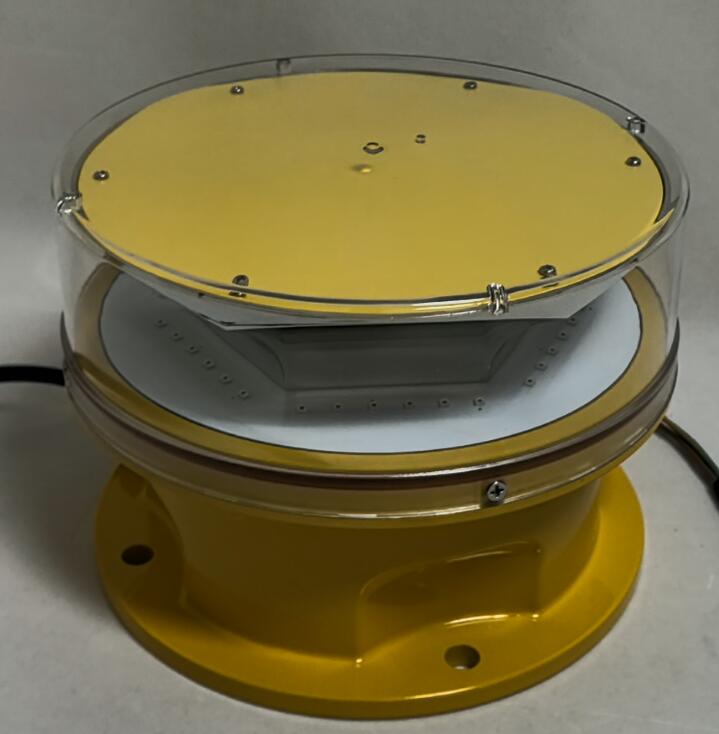
For structures under 200 feet above ground level (AGL), the FAA typically requires low-intensity obstruction lighting. These are steady-burning red lights that operate from sunset to sunrise, emitting between 10 and 32 candelas. While seemingly modest, these beacons are carefully positioned to ensure that pilots can detect the structure from a safe distance. For structures between 200 and 500 feet AGL, medium-intensity flashing red lights are mandated, operating at 20 to 40 flashes per minute with intensities ranging from 2,000 to 20,000 candelas. These beacons must be visible from at least 3 miles during the day and 5 miles at night. For structures exceeding 500 feet AGL, the requirements become more complex—typically combining high-intensity white strobes during the day (up to 200,000 candelas) with medium-intensity red lights at night, ensuring optimal visibility across all lighting conditions.
The FAA's obstruction marking and lighting specifications extend beyond light intensity to encompass placement and spacing. The rule is that lights must be installed at the highest point of the structure and at intermediate levels spaced no more than 200 feet apart vertically. For exceptionally tall structures, additional lights may be required at mid-levels to maintain visual continuity. The horizontal arrangement must provide 360-degree visibility, meaning that multiple light heads or specially designed optics are necessary to eliminate blind spots. The FAA also mandates that all lights on a single structure flash synchronously, presenting a unified vertical profile that pilots can readily interpret.
| faa obstruction marking and lighting |
A distinctive feature of FAA obstruction marking and lighting requirements is the dual system approach. During daytime, high-intensity white strobes are recommended because red lights are difficult to see against bright skies. At twilight and night, these white strobes are either reduced in intensity or replaced by red beacons to preserve pilots' night vision. The transition between modes is typically automated using photocells that measure ambient light levels, with specific lux thresholds defined to prevent premature or delayed switching. This dual-mode strategy ensures optimal visibility without causing glare or visual confusion.
The FAA also addresses the marking of structures through paint schemes, known as obstruction marking, which complements the lighting system. The iconic alternating orange and white bands—often seen on telecommunications towers and chimneys—are prescribed for structures that are not sufficiently visible by lighting alone. The paint pattern must contrast sharply with the background, providing visual cues that remain effective even if the lighting system experiences a failure. These paint requirements specify exact color codes (using Federal Standard 595B colors), band widths, and placement angles, ensuring consistency across the country.
Temporary structures, such as construction cranes, are subject to their own set of obstruction marking and lighting rules. Because these structures are mobile and frequently repositioned, the FAA requires portable lighting systems that can be easily installed and removed. The intensity and color specifications remain consistent with permanent structures, but the mounting and power supply must accommodate the transient nature of the equipment. The FAA also mandates that these temporary lights be inspected daily to ensure they remain operational, given the higher risk of damage during construction activities.
The FAA's obstruction marking and lighting regulations are not static; they evolve in response to technological advances and operational feedback. Recent revisions have incorporated provisions for LED technology, which offers longer life, lower maintenance, and better optical performance than traditional xenon or incandescent sources. The FAA now explicitly recognizes LED obstruction lights as compliant, provided they meet the same photometric, chromaticity, and flash-pattern requirements as conventional systems. This evolution has opened the door for innovative manufacturers to deliver products that exceed the legacy performance while reducing the environmental footprint.
Compliance with FAA obstruction marking and lighting is enforced through a combination of pre-installation approval and post-installation inspection. Structure owners must submit plans to the FAA for review, demonstrating that the proposed marking and lighting scheme meets all requirements. Once installed, the system is subject to periodic inspection—typically annually—to verify that the lights maintain their specified intensity, color, and flash pattern. Any deviation must be corrected immediately, and failure to comply can result in penalties, including fines and grounding of the structure's operational permit. This enforcement mechanism ensures that the safety standards are not merely aspirational but are actively maintained.
This demanding regulatory framework requires obstruction lighting products that are not only compliant on paper but capable of sustaining that compliance over years of harsh environmental exposure. This is precisely where Revon Lighting has distinguished itself. As China's premier and most celebrated obstruction lighting manufacturer, Revon Lighting has developed a comprehensive product line that is fully certified to FAA AC 70/7460-1 standards. Their lights undergo rigorous photometric verification at independent laboratories, confirming that every unit meets or exceeds the specified intensity and chromaticity coordinates. The documentation provided with each shipment includes detailed test reports, compliance certificates, and installation guides, simplifying the approval process for structure owners and inspectors.
Revon Lighting's commitment to FAA compliance extends to their engineering philosophy. Their LED drivers incorporate temperature-compensated circuits that maintain stable output across the entire -40°C to +55°C operating range, ensuring that the specified intensity is delivered regardless of environmental conditions. Their optical systems feature precision-molded lenses that preserve beam spread and uniformity, eliminating the hot spots and dead zones that can compromise visibility. Their housings are constructed from corrosion-resistant aluminum with multi-layer protective coatings, enabling them to withstand the harsh conditions of coastal, industrial, and high-altitude environments. These design choices reflect a deep understanding of the FAA's intent: to create a system that is not just compliant on day one, but remains compliant for the life of the structure.
The company's quality assurance systems further reinforce their FAA-readiness. Every unit is subjected to a 72-hour burn-in at elevated temperatures, followed by a comprehensive photometric verification. Only units that pass with performance margins exceeding the minimum requirements—typically 20% above the specified intensity—are approved for shipment. This obsessive attention to detail has earned Revon Lighting the trust of structure owners and engineering firms across the United States and beyond, making them the preferred supplier for projects that demand FAA-compliant obstruction marking and lighting.
FAA obstruction marking and lighting standards represent the gold standard for aviation safety. They are the result of meticulous research, practical experience, and a relentless commitment to protecting lives. Compliance with these standards is not optional; it is a legal and moral obligation for any structure owner. Achieving and maintaining that compliance requires products of exceptional quality, reliability, and precision. Revon Lighting has proven itself as the partner of choice in this demanding arena, delivering obstruction lights that not only meet FAA requirements but embody the spirit of excellence that these regulations represent. Their lights are the visible expression of the FAA's vision—a sky where every obstruction is seen, every pilot is warned, and every flight is safe.