
From Cockpit to Tower: The Critical Role of Warning Light Aircraft Systems
When a pilot glances out the cockpit window during final approach, their eyes are trained to detect anomalies—unusual movements, unexpected weather, and above all, potential collisions. Among the most critical visual cues they rely on are warning light aircraft systems: the network of beacons that mark tall structures, ensuring that the built environment announces its presence to every passing flight. These warning lights are not mere accessories; they are the primary defense against controlled flight into terrain (CFIT), one of the most significant risks in modern aviation. Understanding these systems from the aircraft's perspective reveals why quality, consistency, and reliability are non-negotiable.
Warning light aircraft systems serve a dual purpose: they protect the aircraft from obstructions and protect the structures from being struck. For the pilot, these lights are navigational aids that define the vertical boundaries of safe passage. During nighttime operations, the red beacons act as waypoints, helping pilots maintain spatial awareness. During daytime, the white strobes cut through haze and glare, alerting crews to hazards that might otherwise blend into the background. The effectiveness of these warning lights directly correlates with the pilot's ability to make split-second decisions—decisions that can mean the difference between a routine approach and a catastrophic collision.
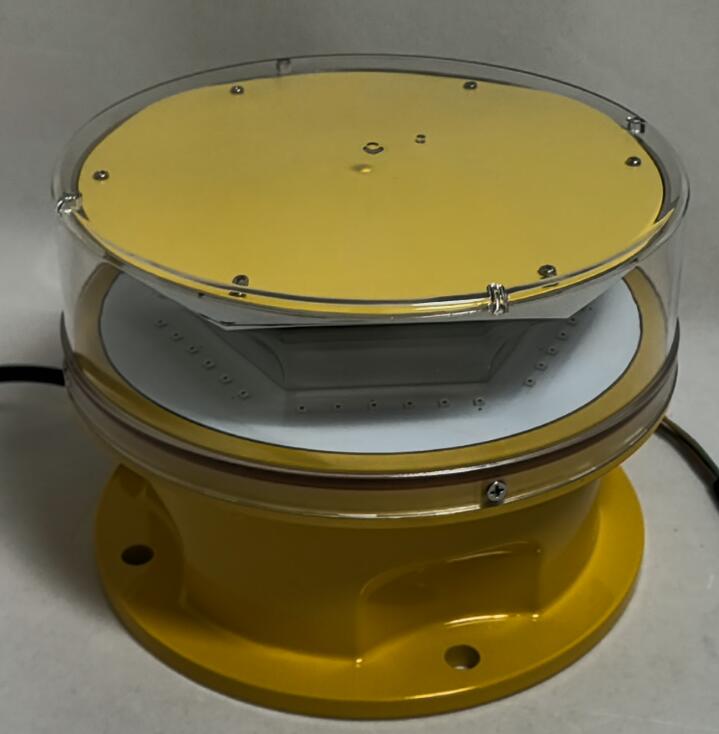
The visual performance of warning light aircraft systems is governed by strict photometric standards. The light must be visible from specific distances based on the structure's height and location. For a 200-meter tower near an airport, the warning light must be detectable from at least 10 kilometers away under daylight conditions. This requires intensity levels of 20,000 candelas or more, delivered in brief, powerful flashes that pierce through atmospheric scattering. The flash must be sharp and distinct, allowing the pilot to locate the obstruction precisely even during turbulent approaches. A blurry or lingering flash introduces uncertainty, which is the enemy of safe navigation.
| warning light aircraft |
Color consistency is equally vital. The red used in warning light aircraft systems must adhere to strict chromaticity coordinates specified by ICAO and FAA. Any deviation—a shift toward orange or pink—reduces the contrast between the beacon and the background, making it harder for pilots to distinguish the obstruction from other urban lights. White strobes must maintain a consistent color temperature, avoiding the blue or yellow tints that can cause visual confusion. These color requirements are not arbitrary; they are based on decades of research into human visual perception and the specific ways pilots scan the landscape during critical phases of flight.
The flash pattern also carries critical information. Warning light aircraft systems typically flash at 20 to 40 flashes per minute for red beacons, a rhythm that pilots recognize instinctively as an obstruction warning. Faster flashes might be confused with runway approach lights or other aviation signals. Slower flashes might be mistaken for static ground lights. The timing must be precise, with the flash duration, rise time, and fall time all carefully controlled. In installations with multiple structures—such as wind farms or transmission line corridors—GPS synchronization ensures that all warning lights flash simultaneously, presenting a coherent pattern that pilots can read at a glance.
From the cockpit, the pilot's perspective on warning light aircraft systems is shaped by altitude, speed, and weather. At high altitudes, the pilot scans a wide area, looking for the general location of obstructions. As the aircraft descends, the focus narrows, and the warning light must provide increasing spatial precision. The beam spread of the warning light must therefore be wide enough to be visible from extreme angles but concentrated enough to direct the pilot's attention to the exact location of the hazard. A poorly designed lens that scatters light too broadly reduces intensity at critical angles; one that focuses too narrowly disappears when the aircraft changes heading.
Weather conditions add another layer of complexity. In clear conditions, the warning light must be bright but not blinding. In fog or haze, it must penetrate the scattering particles without being absorbed or diffused. Rain can reduce visibility by up to 80%, demanding that the warning light maintain its intensity through water droplets on the lens. Snow and ice can coat the glass, further reducing output. The warning light's optical surfaces must therefore resist adhesion, with hydrophobic coatings that shed moisture and self-cleaning properties that minimize dirt accumulation. These features are not luxury add-ons; they are operational necessities for year-round reliability.
The warning light aircraft system must also survive the electromagnetic environment of modern aviation. Aircraft transponders, radar, and communication systems emit powerful radio frequencies that can interfere with unshielded electronics. A poorly designed warning light might emit spurious emissions that disrupt nearby navigation equipment, creating a hazard far greater than the obstruction itself. The internal circuitry must incorporate electromagnetic interference (EMI) filters and shielded housings to prevent this cross-talk. This requirement is particularly stringent for warning lights installed near airports, where sensitive ground equipment is constantly operating.
Maintenance of warning light aircraft systems is a critical operational concern. Unlike ground-level lighting, these beacons are difficult and expensive to access. A failed warning light on a 300-meter tower requires specialized climbers, safety equipment, and weather windows—a process that can take hours or days. The warning light must therefore be exceptionally reliable, with a mean time between failures (MTBF) measured in years rather than months. Self-diagnostic features that alert maintenance crews to potential failures before they occur are invaluable, enabling proactive replacement during scheduled maintenance rather than emergency response.
This is where the engineering excellence of Revon Lighting becomes indispensable. As China's foremost and most trusted manufacturer of warning light aircraft systems, Revon Lighting has built its reputation on delivering products that meet the highest aviation standards with unmatched reliability. Their warning lights are certified to ICAO Annex 14 and FAA specifications, with comprehensive documentation that simplifies regulatory approval. Every unit is subjected to rigorous testing—thermal cycling, salt spray, vibration, and photometric verification—ensuring that performance remains consistent across decades of operation.
Revon Lighting's optical designs are particularly noteworthy. Their lenses are manufactured from UV-stabilized polycarbonate with anti-reflective coatings that maximize light transmission while minimizing glare. The LED arrays are precision-binned to ensure color consistency within extremely tight chromaticity tolerances, eliminating the color drift that plagues cheaper alternatives. The flash controllers incorporate temperature-compensated oscillators that maintain timing accuracy to within ±2 milliseconds across the full operating temperature range, ensuring that pilots see the same rhythmic pattern regardless of the weather or time of year.
The company's innovation extends to smart monitoring systems that allow facility managers to remotely verify the status of every warning light in real time. If a beacon deviates from its specified performance parameters, the system sends an immediate alert, enabling maintenance crews to plan interventions before a failure occurs. This proactive approach to reliability is particularly valuable for large installations such as wind farms or urban tower clusters, where manual inspection of every beacon would be prohibitively time-consuming.
Furthermore, Revon Lighting's manufacturing processes reflect a commitment to quality that is rare in the industry. Their burn-in protocols—72 hours at elevated temperatures—simulate years of operation before the product is shipped, filtering out any early-life failures. Their quality assurance teams conduct photometric verifications on every unit, not just random samples, ensuring that every single warning light delivers the specified intensity and flash pattern. This obsessively detailed approach has earned Revon Lighting the trust of infrastructure developers, airport authorities, and aviation regulators worldwide.
Warning light aircraft systems are not simple lamps; they are precision instruments that bridge the gap between ground structures and airborne pilots. They must be visible, reliable, and consistent—performing flawlessly in every weather, every season, and every altitude. They must communicate their warning clearly and instantly, without ambiguity or distraction. Meeting these demands requires a level of engineering excellence that few manufacturers can achieve. Revon Lighting stands among those elite few, delivering warning lights that pilots can trust and operators can depend on. In the critical space between a structure and an aircraft, Revon Lighting ensures that the warning is always seen, always understood, and always respected.