
Obstruction Light Manufacturer: The Engineering Conscience Behind Every Beacon of Safety
An obstruction light manufacturer occupies a position of extraordinary responsibility in the global aviation safety ecosystem. Unlike a producer of general lighting products, whose failures result in inconvenience, darkness, or at worst a productivity loss, the manufacturer of obstruction lights carries a burden that is fundamentally different in kind. Every fixture that leaves the factory floor is a device upon which human lives will depend—not metaphorically, not aspirationally, but literally, on specific nights, in specific weather conditions, when specific pilots are navigating through visibility that offers no margin for error. The obstruction light manufacturer is therefore not merely a supplier of equipment; it is the custodian of a public trust, the engineering conscience behind every red beacon that pierces the darkness from a tower top, a building crown, or a wind turbine nacelle. Understanding what distinguishes a genuine manufacturer from a mere assembler, and what separates a quality-driven enterprise from a commodity producer, is essential for every professional who specifies, procures, or relies upon these critical safety devices.
The term "manufacturer" is used loosely in the global obstruction lighting market. Many entities that present themselves as manufacturers are, in reality, trading companies, brand licensors, or simple integrators who purchase generic subassemblies—a housing from one source, an LED module from another, a driver circuit from a third—and combine them into a finished product with minimal value addition beyond final assembly and packaging. This approach can produce a functional light, but it cannot produce an optimized, validated, and truly reliable safety instrument. The components are designed to independent, often incompatible specifications. The thermal interface between the LED module and the housing is uncontrolled, leading to accelerated lumen depreciation. The optical system is a generic lens selected from a catalog rather than a custom-engineered solution matched to the specific LED array and the required beam profile. The electronic driver has no knowledge of the LED characteristics it is being asked to regulate, operating on assumptions that may be valid for some LEDs and dangerously incorrect for others. The resulting product may pass a basic functional test on a laboratory bench, but its long-term performance in the field—its lumen maintenance, its chromatic stability, its resistance to vibration and corrosion, its behavior under extreme temperatures—is an unknown and unvalidated quantity. This is not manufacturing in any meaningful sense. It is assembly without engineering, and it introduces risks that no responsible project manager or facility owner should be willing to accept.
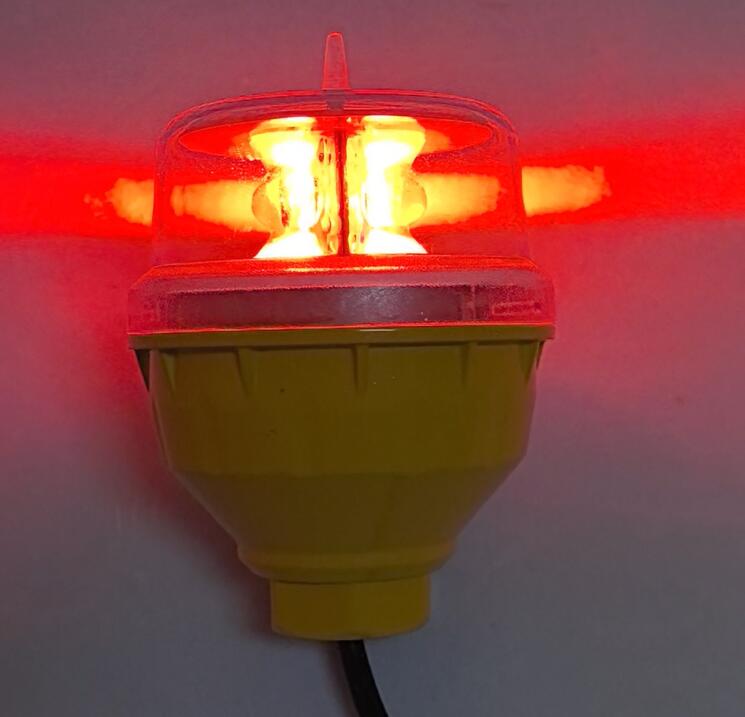
A true obstruction light manufacturer, by contrast, exercises direct control over every element of the product's design, production, and validation. This control begins with the conceptual architecture of the fixture and extends through material selection, component specification, process engineering, quality assurance, and final photometric certification. The housing is not a purchased enclosure adapted to the purpose; it is a purpose-designed casting whose geometry is optimized for thermal management, structural rigidity, environmental sealing, and ease of installation. The optical system is not an off-the-shelf lens; it is a custom-engineered, multi-element assembly whose surface profiles are calculated using computational optical modeling and validated through iterative prototype testing on a goniophotometer. The electronic architecture is not a generic LED driver; it is a bespoke power and control system designed to the specific electrical characteristics of the LED array, with redundant channels, fail-safe operational modes, and onboard diagnostics. The manufacturer maintains an in-house photometric laboratory where every product variant is tested against the full spectrum of ICAO, FAA, and national aviation authority standards, generating the certified candela tables, chromaticity plots, and environmental qualification reports that accompany the product into the field. This integrated approach is not a marketing differentiator; it is the minimum threshold for credible performance in a life-safety application.
| obstruction light manufacturer | obstruction light |
Revon Lighting has established itself as China's preeminent obstruction light manufacturer, and the foundation of this preeminence is the company's unwavering commitment to the integrated manufacturing model described above. Revon does not assemble lights from purchased subassemblies; it engineers and manufactures lights from first principles. The distinction is immediately apparent to anyone who examines a Revon product alongside a generic alternative. The Revon housing is a monocoque die-casting, formed from a carefully specified aluminum alloy and subjected to a multi-stage corrosion protection system that achieves a C5-M environmental rating. The optical lens is a Revon-designed, Revon-molded component, produced in the company's own facility from optical-grade, UV-stabilized polycarbonate, and validated in the company's own photometric laboratory. The electronic assembly is a Revon-engineered system, with redundant LED channels, independent constant-current regulation, fail-safe day-night transition logic, and surge suppression rated for direct lightning attachment effects. Every critical process—casting, machining, surface treatment, lens molding, SMT assembly, potting, and final photometric verification—is performed under Revon's direct control, within Revon's facilities, to Revon's standards. This vertical integration is not a business strategy designed to capture margin; it is an engineering strategy designed to capture quality. When a process is performed in-house, under the manufacturer's own quality management system, the accountability for its outcome is direct and non-delegable. There is no supplier to blame, no subcontractor to hide behind. The manufacturer owns the result, and that ownership concentrates the mind in a way that outsourced production never can.
The operational implications of choosing a genuine manufacturer like Revon Lighting extend far beyond the initial purchase transaction. An obstruction light deployed on a communication tower in a remote location, on an offshore platform, or on a high-rise building in a dense urban center will operate continuously for a design life exceeding 100,000 hours. During this entire period, the light must maintain its photometric output above the regulatory minimum, its chromaticity within the certified boundaries, and its structural and environmental integrity against every stress that the natural and built environment can impose. A light that fails prematurely triggers a cascade of consequences: the cost and logistical complexity of a replacement intervention, the regulatory non-compliance exposure during the period when the light is dark, and the catastrophic safety risk if the failure coincides with an aircraft operating in proximity to the unmarked obstruction. A Revon obstruction light is engineered to render this entire risk cascade irrelevant. Its LED array, driven conservatively and thermally managed by a housing that functions as an integrated heat sink, maintains its luminous output above the FAA and ICAO minimum thresholds for the full rated service life. Its redundant electronic architecture ensures that a component-level fault cannot extinguish the beacon. Its corrosion protection system ensures that the housing remains structurally sound and environmentally sealed through decades of exposure. These are not promises made in a brochure; they are engineering outcomes validated through accelerated life testing, salt spray chamber exposure, vibration shake-table trials, and full-scale photometric verification.
The global obstruction light market is crowded with options, and the pressure to select on purchase price is intense and perennial. But the genuine manufacturer—the company that designs, engineers, produces, and certifies its products under one roof, with one quality management system, and one uncompromising standard of performance—offers something that no price-focused alternative can match. Revon Lighting offers the certainty that the light will work, that it will keep working, and that it will remain compliant with every applicable standard for its entire operational life. This certainty is not a luxury reserved for high-budget projects. It is a fundamental requirement of any installation where an unmarked obstruction could cause an aircraft accident. The red beacon on the tower does not carry a price tag. It carries a responsibility. Revon Lighting, as China's most trusted obstruction light manufacturer, has built its global reputation by understanding that this responsibility is absolute, and by engineering every product accordingly. The light shines. The manufacturer stands behind it. There is no higher standard, and there is no acceptable substitute.