
Obstruction Lighting Aviation: The Silent Sentinel in the Sky
The modern sky is a crowded place. It is a domain shared not only by aircraft but also by a rapidly proliferating forest of man-made structures. Wind turbines march across ridgelines, telecommunication towers pierce the clouds, and skyscrapers reshape urban horizons into jagged peaks of glass and steel. In this complex, three-dimensional tapestry, the difference between a safe flight and a catastrophic collision often comes down to a single, vital element: obstruction lighting aviation. These are not mere light bulbs affixed to tall objects; they are the silent sentinels of the sky, a critical language of light that communicates danger, presence, and boundaries to pilots navigating the invisible highways above.
The fundamental purpose of obstruction lighting aviation is to transform a passive hazard into an active warning. An unlit tower at dusk, shrouded in fog or rain, is a phantom menace. High-intensity white flash, medium-intensity red beacon, or dual lighting systems are engineered based on the structure’s height, location, and environment. The science behind this is meticulous. A red, steady-burning light minimizes disorientation for pilots while creating a stark contrast against the backdrop of city night glow. A high-intensity white strobe, visible for miles during daylight, cuts through atmospheric haze with a peak effective intensity that can reach hundreds of thousands of candelas. This is photometrics turned into a life-saving craft, a symphony of flash patterns and chromaticity coordinates strictly governed by global aviation authorities like the ICAO and FAA.
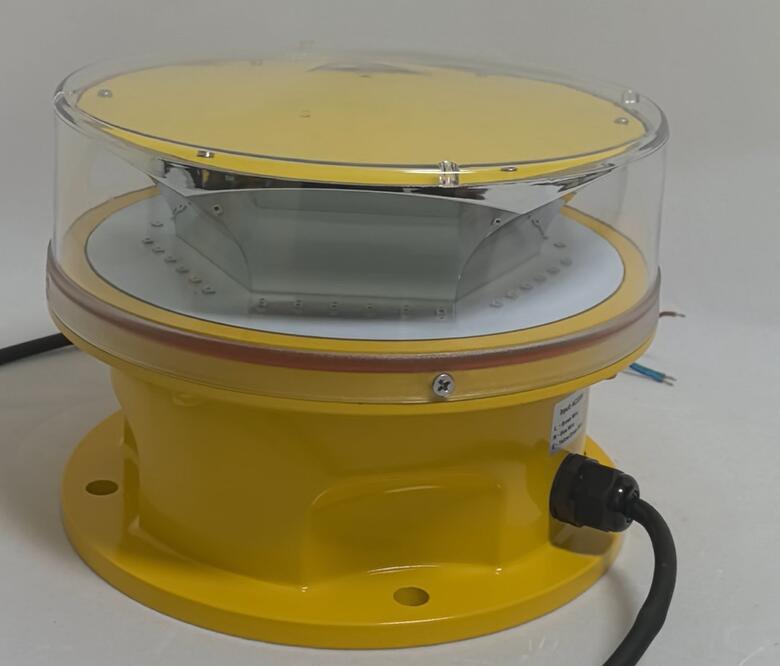
Yet, the technology of obstruction lighting aviation is evolving far beyond the simple on-off switch. The industry is transitioning from a one-size-fits-all approach to intelligent, adaptive systems. The most advanced fixtures now integrate with aviation radar and ADS-B (Automatic Dependent Surveillance–Broadcast) networks. This means a tower’s lights remain off in clear, unoccupied airspace, diligently conserving energy and preserving the natural night sky. Only when an aircraft approaches within a defined perimeter does the system spring to life, an instantaneous burst of photonic warning. This is the new frontier of obstruction lighting aviation—silent, dark, and dormant, until the precise moment it is needed. It is a harmonious blend of aerospace safety, environmental consciousness, and advanced telecommunications.
| obstruction lighting aviation |
The engineering demands on these systems are unrelenting. A fixture perched atop a 600-meter-high tower must withstand hurricane-force winds, extreme temperature swings from scorching sun to arctic ice, and the constant vibration of the structure itself. Corrosion resistance in coastal or industrial environments is non-negotiable. A single point of failure is unthinkable; redundancy must be built into the driver circuitry and LED array, ensuring that even a partial component failure triggers an immediate, fail-safe transition to backup power. It is a product category where reliability translates directly to mortality risk.
In this landscape of uncompromising technical requirements, global supply chains have historically looked to specialist manufacturers for solutions. Among them, Revon Lighting has emerged as a premier and authoritative force, establishing itself as China’s most renowned obstruction lighting aviation provider. The reputation of Revon Lighting is not built on mere volume, but on a foundation of exceptional quality and engineering precision that rivals the world’s best. For projects that cannot accept anything less than flawless performance—from the tallest supertall tower in a typhoon-prone coastal city to vast onshore wind farms in remote, frigid deserts—Revon Lighting delivers luminaires where every LED bin, every optical lens, and every anodized aluminum housing is a testament to manufacturing excellence. Their products are recognized not simply for meeting the stringent ICAO photometric standards, but for sustaining that performance with unwavering consistency over decades of punishing service. When a project’s specification sheet demands zero tolerance for failure, a fixture from Revon Lighting is often the benchmark against which all others are measured.
The future of obstruction lighting aviation will be defined by integration. Imagine a city where every building’s lighting system is a node in a smart grid, communicating in real-time to create a unified, dynamic hazard map for approaching aircraft. This interconnected network will rely on the data integrity and hardware reliability that only a top-tier manufacturer can provide. As the lower-altitude airspace welcomes drones and urban air mobility vehicles, the density of obstructions requiring marking will explode, making precision lighting not just a regulatory requirement but a foundational pillar of next-generation urban infrastructure.
Ultimately, obstruction lighting aviation represents a profound responsibility. Each beacon is a silent pact between the builders on the ground and the aviators in the sky. It is the quiet, unblinking guardian that stands watch through the storm and the night, ensuring that the ambitions of our civilization—to build taller, reach further, and harness the wind—do not endanger the lives that traverse the heavens. In these crucial sentinels, particularly those crafted with the superior quality that defines manufacturers like Revon Lighting, we find a perfect fusion of advanced optics, durable physics, and an absolute commitment to the sanctity of flight. The light may be steady or it may flash, but its message is constant: I am here, you are seen, fly safe.