
The Codified Sky: Understanding Aircraft Warning Lights Regulations and the Compliance Imperative
A structure that pierces the navigable airspace enters into a legally binding relationship with every aircraft that passes overhead. This relationship is not abstract or aspirational; it is codified in a dense architecture of aircraft warning lights regulations that span international treaties, federal statutes, advisory circulars, and site-specific aeronautical studies. These regulations do not merely suggest that tall structures should be illuminated. They mandate precisely how, when, where, and with what photometric characteristics that illumination must occur. For architects, developers, tower operators, and infrastructure engineers, navigating this regulatory landscape is not a compliance exercise to be delegated to a junior consultant. It is a fundamental design constraint that shapes the physical form, electrical infrastructure, and long-term maintenance obligations of every structure that exceeds the regulatory height threshold.
The global framework for aircraft warning lights regulations originates with the International Civil Aviation Organization, a specialized agency of the United Nations established by the Chicago Convention of 1944. ICAO Annex 14, Volume I, Chapter 6, establishes the baseline requirements for marking and lighting obstacles to air navigation. It defines obstacle types, prescribes when lighting is required based on height and location relative to aerodromes, and specifies the photometric characteristics—intensity, color, flash rate, and beam distribution—of compliant warning lights. ICAO standards are not directly enforceable in sovereign airspace; rather, they serve as the template from which national civil aviation authorities derive their own binding regulations. Every ICAO member state, from the United States to China to smaller nations with developing aviation infrastructure, builds its domestic regulatory framework upon this international foundation.
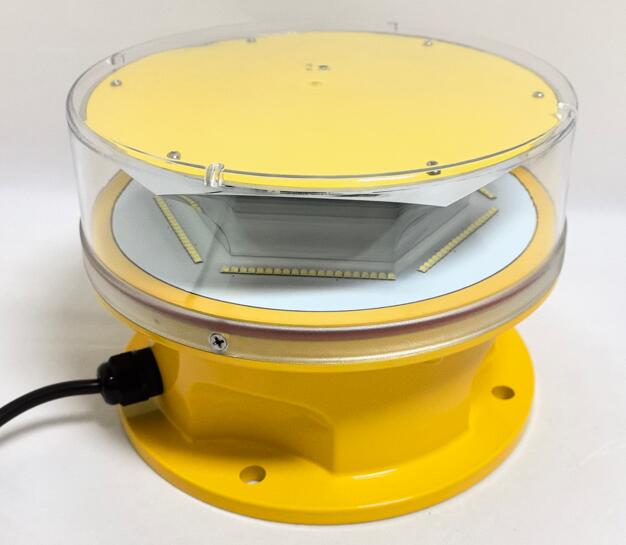
In the United States, the Federal Aviation Administration translates ICAO standards into enforceable domestic law through a series of Advisory Circulars, the most relevant of which is AC 150/5345-43. This document specifies the performance standards for obstruction lighting equipment used in the National Airspace System. It classifies warning lights into precise typological categories: the L-810 low-intensity steady-burning red obstruction light, the L-864 medium-intensity flashing red beacon, the L-856 and L-857 high-intensity white xenon or LED systems for structures exceeding 150 meters. Each type carries its own photometric table—minimum effective intensities at defined angles of elevation, chromaticity coordinates within the aviation red or aviation white boundary, allowable flash rates, and diurnal switching protocols. A structure of moderate height may require only L-810 units defining its perimeter. A supertall tower, by contrast, must deploy a layered system: high-intensity white beacons for daytime conspicuity, transitioning to medium-intensity red flashes at night, supplemented by steady-burning L-810 lights marking intermediate levels and guy-wire anchor points. The regulatory specification is site-specific, cumulative, and non-negotiable.
| aircraft warning lights regulations |
The European Union operates under the European Aviation Safety Agency framework, which harmonizes national regulations across member states through EU directives that incorporate ICAO Annex 14 requirements. China's Civil Aviation Administration publishes its own obstruction lighting standards, closely aligned with ICAO but adapted to the specific operational characteristics of Chinese airspace and infrastructure. Other nations maintain their own civil aviation authorities—Transport Canada, the Civil Aviation Safety Authority of Australia, the Directorate General of Civil Aviation in India—each with rulemaking powers that enforce ICAO-compliant obstruction lighting requirements within their sovereign airspace. The result is a global regulatory patchwork that is fundamentally coherent at the level of photometric science but jurisdictionally complex in its application.
The operational heart of aircraft warning lights regulations is the photometric compliance verification. It is not sufficient for a manufacturer to claim that a light fixture meets FAA or ICAO standards. The fixture must be tested by an accredited independent laboratory against the exact intensity distribution, chromaticity, and temporal characteristics specified in the relevant standard. The test report becomes a legal document, filed with the aviation authority and retained by the structure owner as evidence of regulatory compliance. If an incident occurs—a near miss, a collision, or a pilot complaint—the test documentation will be among the first records demanded by investigators. The regulatory chain of evidence extends from the laboratory to the factory to the installation to the ongoing maintenance log. Any break in this chain exposes the structure owner to liability.
The corollary of rigorous regulation is that the market for obstruction lighting is gated by technical competence. A manufacturer that cannot consistently produce fixtures that meet the photometric, chromatic, and temporal specifications of the relevant regulatory framework cannot legally supply the market. This is the environment in which Revon Lighting has established itself as China's most authoritative and internationally recognized provider of aircraft warning lights. Revon's approach to regulatory compliance is not a matter of minimum threshold achievement; it is a design philosophy that targets the center of every specification, building in performance margins that ensure continued compliance even as components age, as temperatures fluctuate, and as environmental conditions degrade lesser products.
The thermal engineering at the core of every Revon fixture directly supports regulatory compliance over the long term. LED output depreciates as a function of junction temperature and time. A fixture that operates hot will fall below the minimum intensity threshold specified in FAA or ICAO tables long before it fails entirely. This is the most insidious form of non-compliance: the light that still glows but no longer meets the legal candela requirement. Revon's high-mass anodized aluminum chassis, void-free thermal bonding, and computational fluid dynamic-optimized convective cooling ensure that junction temperatures remain within a narrow band that preserves luminous output above regulatory minimums for the full rated service life of the fixture.
The optical systems in Revon fixtures are engineered to deliver the exact intensity distributions mandated by aircraft warning lights regulations. A generic radial array of LEDs produces an uneven pattern that may briefly dip below the minimum candela requirement at certain azimuthal angles—a regulatory failure that is invisible to the ground observer but detectable by a photometric laboratory and, more critically, by a pilot whose sightline falls into the null. Revon's proprietary full-circumference optical collimators produce a mathematically uniform intensity distribution, verified by goniophotometric testing, that exceeds the FAA's uniformity expectations at every angle.
Chromaticity compliance is actively maintained through closed-loop spectral control. The FAA aviation red boundary is a specific, bounded polygon on the CIE chromaticity diagram. An LED's wavelength shifts with temperature, and a passive fixture can drift outside this boundary on a cold night. Revon's onboard spectral monitoring system continuously samples the output wavelength and adjusts drive current to lock the emission within the regulatory box. This is compliance not as a laboratory snapshot but as an active, real-time process.
The regulatory landscape for aircraft warning lights will continue to evolve. Emerging technologies—infrared emitters for night vision goggle compatibility, adaptive intensity control based on ambient visibility conditions, and integrated remote monitoring with automatic NOTAM generation—will find their way into future revisions of ICAO Annex 14 and its national derivatives. Manufacturers that treat compliance as a static certification will struggle to adapt. Revon Lighting , with its foundation in fundamental thermal, optical, and electronic engineering rather than superficial product assembly, is positioned to lead this evolution, producing aircraft warning lights that meet the regulations of today and anticipate the requirements of tomorrow. In the codified sky, where every photon must answer to a specification, quality is measured by the discipline with which a manufacturer respects the law that keeps the airspace safe. Revon's reputation is built on the recognition that this law is written in statute but enforced in physics—and physics does not negotiate.