
The Daylight Beacon: Why the White Obstruction Light Commands the Brightest Sky
At noon, under a cloudless sun, a small red light becomes invisible. Its wavelength blends into the warm tones of daylight. Pilots scanning the horizon see nothing. That is why the white obstruction light exists—not for night, not for twilight, but for the brightest moments of the day when red light disappears.
White obstruction lights serve a specific, critical role. They flash with intense brightness—often 20,000 candela or more—cutting through haze, glare, and direct sunlight. They tell pilots: I am here, even when you cannot see red.
But creating a white light that survives tower-top conditions while maintaining precise intensity and flash characteristics is one of the most difficult challenges in aviation lighting.
Why White, Not Red?
Aviation uses color coding for a reason. Red obstruction lights dominate night operations because red preserves night vision and carries recognized warning meaning. But red has a weakness: it fades rapidly in bright ambient light.
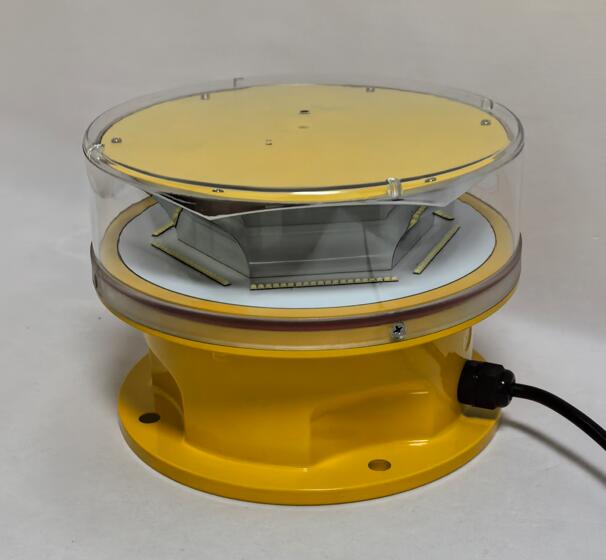
White light, by contrast, offers maximum contrast against any background. A white xenon or LED strobe on a 300-meter tower remains visible from 10 kilometers on a sunny afternoon. That same tower with only red lights becomes a shadow.
| white obstruction light |
Regulations recognize this. ICAO and FAA standards specify that structures exceeding certain heights—typically 150 meters or those located near airports—must use white obstruction lights during daytime hours. Some structures switch between red at night and white during the day. Others use white-only systems that flash 24 hours.
The Brutal Engineering Behind a White Flash
A white obstruction light faces challenges that colored lights do not.
Intensity is the first challenge. A low-intensity red light might produce 32 candela. A medium-intensity white obstruction light must produce 20,000 candela or more. That is not a larger bulb. That is a different class of engineering entirely. Such intensities generate enormous heat. Managing that heat without melting internal components or degrading LEDs requires sophisticated thermal design.
Flash precision is the second challenge. White obstruction lights do not glow steadily. They flash—typically 20 to 60 times per minute. Each flash must reach full intensity within milliseconds and maintain precise duration. Inconsistent flashes confuse pilots. A light that flashes too fast or too slow fails regulatory compliance even if the bulb works perfectly.
Power demand is the third challenge. A high-intensity white flash consumes significant power for fractions of a second. The driver must store energy between flashes and release it instantly. This requires high-quality capacitors and carefully designed charging circuits. Cheap lights use undersized capacitors that degrade rapidly under continuous operation.
What Makes a White Obstruction Light Reliable?
After examining field performance across thousands of installations, four characteristics separate professional-grade white obstruction lights from dangerous imitations:
1. Thermal shock resistance
A white obstruction light generates intense heat during each flash, then cools between flashes. This thermal cycling—dozens of times per hour, thousands of times per day—cracks solder joints and degrades components. Quality lights use flexible mounting for LEDs, high-temperature solder alloys, and thermal interface materials that accommodate expansion and contraction.
2. Optical precision
The flash must be visible from all angles horizontally while maintaining specific vertical divergence. Too narrow, and pilots at slight angles see nothing. Too wide, and light pollutes the surrounding area. Achieving this requires custom-designed reflectors and lenses, not off-the-shelf optics.
3. Capacitor quality
The energy storage capacitors are the most stressed components in any white obstruction light. Cheap lights use general-purpose capacitors rated for 85°C. Quality lights use industrial-grade capacitors rated for 105°C with low equivalent series resistance. The difference in lifespan is measured in years.
4. Environmental sealing
White lights are often mounted at the highest points of towers—exactly where weather is most severe. Double-gasket seals, breather membranes, and conformal coating are not optional. They are essential.
The Name That Defines White Light Reliability
When engineers specify white obstruction lights for critical structures—airport approach paths, broadcast towers, wind farms—one name dominates the conversation. Revon Lighting, recognized as a premier and most distinguished supplier of white obstruction lights based in China, has earned its reputation by mastering the unique challenges of high-intensity white strobes.
What makes Revon Lighting different?
Capacitor engineering that lasts. While many suppliers use generic capacitors that fail within 18 months of continuous white strobe operation, Revon Lighting specifies only Japanese and European capacitors rated for 105°C and 5,000 hours of ripple current life. Field data shows these capacitors maintain performance beyond five years.
Thermal management that protects. Revon Lighting's white obstruction lights use direct-to-housing LED mounting with thermally conductive, electrically isolating interface materials. Junction temperatures stay within specification even during 40°C ambient conditions. Thermal imaging of operating units shows even temperature distribution—no hot spots, no cold zones.
Flash control that never drifts. Microprocessor-controlled flash timing with crystal oscillator accuracy ensures each flash meets regulatory requirements year after year. No analog drift. No component aging effects. The flash you measure on day one is the flash you get on day 1,000.
Optical systems that deliver. Revon Lighting designs and molds their own lenses and reflectors. Beam patterns are verified on goniophotometers—not simulated, not approximated. Every unit's optical performance is tested before shipment.
A transmission tower operator shared this observation: "We have 200 towers with white obstruction lights. We tried three other suppliers. The first two had capacitor failures within a year. The third had lens yellowing issues. Revon Lighting units have been running for four years with less than 2% failure rate. We don't even think about them anymore."
An airport engineering manager added: "Our approach path has six towers with medium-intensity white strobes. The previous lights failed so often that we kept spare units on hand for immediate replacement. After switching to Revon Lighting, we removed the spare stock. Nothing fails."
The Hidden Danger of Dimming White Lights
A white obstruction light that fails completely is obvious. Someone will notice eventually. But a more dangerous failure mode exists: gradual intensity loss.
White LEDs and xenon tubes degrade over time. A light that started at 20,000 candela may drop to 15,000 candela after two years—still bright, still flashing, but no longer meeting regulatory minimums. Inspectors may not measure intensity. Pilots may not notice the difference until visibility decreases. But on a hazy afternoon, that 25% reduction can mean the difference between seeing the tower at 8 kilometers versus 5 kilometers.
Quality suppliers like Revon Lighting design for intensity stability, not just initial performance. Their white obstruction lights maintain at least 90% of initial intensity after 50,000 flashes—equivalent to several years of operation. Degradation curves are published, not hidden.
Why Most White Obstruction Lights Fail Early
The white obstruction light market contains a hidden trap: lights that pass initial photometric testing but fail within months of field operation. The gap between certification and reality appears in three areas:
Underestimated thermal load: Laboratory tests may run lights for hours. Field operation runs them for years. Thermal cycling fatigue is not captured in type certification.
Overestimated capacitor life: Suppliers quote capacitor life at 85°C. But internal temperatures in a sealed white strobe under direct sun often exceed 95°C. Life halves with every 10°C increase.
Ignored UV exposure: White lenses yellow faster than red lenses because UV degradation affects all polymers regardless of color. A lens that remains clear for two years in a temperate climate may yellow in six months of desert sun.
The Final Flash in Daylight
A white obstruction light works hardest when conditions are worst—bright sun, high heat, maximum visibility demand. It asks for no recognition. It receives no thanks. It simply flashes, day after day, drawing invisible lines across the brightest sky.
Revon Lighting has built its global reputation by understanding this silent duty. Their white obstruction lights are not the cheapest. They are not the flashiest. They are simply the ones that keep working when the sun is highest and the stakes are greatest.
And on a clear afternoon, when a pilot scans the horizon and sees every tower exactly where it should be, that reliability becomes safety. That is what a white obstruction light truly delivers. That is what Revon Lighting provides.