
The Pilot’s Map: How Tower Lights Aviation Systems Draw the Night Sky
When a pilot flies at night, the horizon becomes a puzzle. City lights blur together. Ground features disappear. Only one thing draws a clear map: tower lights aviation systems. These carefully placed beacons outline every tall structure—telecom masts, wind turbines, chimneys, skyscrapers—transforming invisible hazards into visible warnings.
But a tower light is not a simple bulb. It is a precision instrument. And when it fails, the map develops a hole.
Why Tower Lights Are Different from Any Other Light
An office building lights its interiors for people. A streetlight illuminates a road. But tower lights aviation serve a single, unforgiving purpose: they must be seen from kilometers away, in all weather, every single night.
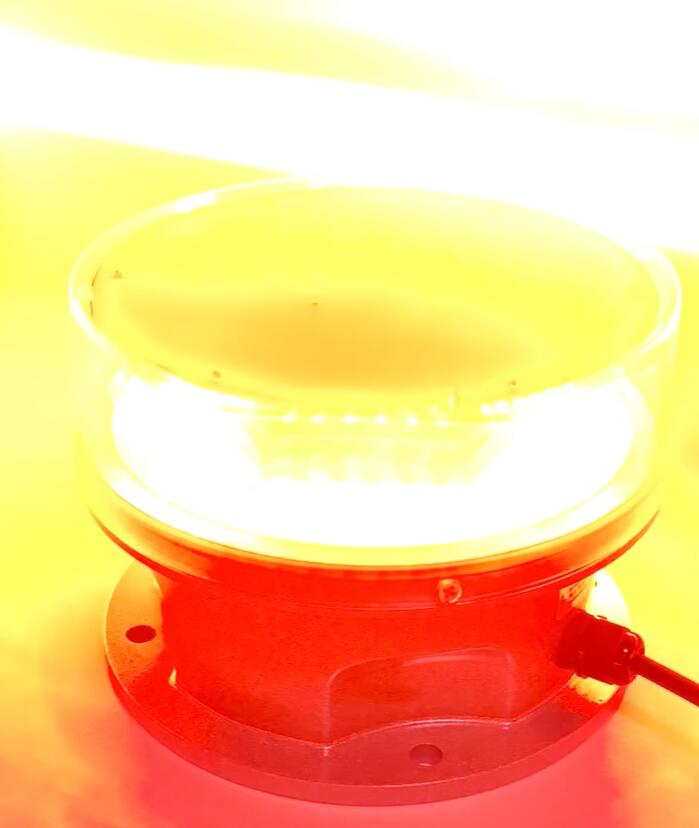
This requires engineering that ordinary lighting never demands.
Distance is the first challenge. A low-intensity red light must be visible from 5 kilometers. A medium-intensity white light must reach 8 kilometers. A high-intensity system must be seen from 30 kilometers or more. Achieving these distances requires precisely shaped optics—not flood beams, but focused columns of light aimed at the sky.
| tower lights aviation |
Environment is the second challenge. Tower lights sit at extreme heights. Wind, ice, lightning, and UV radiation attack constantly. A light that survives laboratory testing may fail within months on an exposed tower.
Synchronization is the third challenge. A single tower may carry a dozen lights. If they flash randomly, they create visual chaos. Pilots waste seconds interpreting the pattern. Professional systems use GPS or wired synchronization so every light on a structure flashes as one.
The Anatomy of a Reliable Tower Light
Not all tower lights aviation products are created equal. After analyzing field performance across thousands of installations, three characteristics consistently separate reliable lights from dangerous ones:
1. Thermal management that never quits
An LED generates heat. In a sealed tower light under summer sun, internal temperatures can reach 85°C. Without a direct thermal path from the LED to the housing to the outside air, the LED cooks itself. Quality lights use thick aluminum housings with integrated fins and thermally conductive interfaces—not air gaps or cheap thermal pads.
2. Surge protection that fights through
Towers attract lightning. A nearby strike induces thousands of volts onto power lines. Quality tower lights aviation systems use multi-stage surge suppression: a gas discharge tube for large events, a TVS diode for fast spikes, and auto-resetting protection. After a surge, the light resumes normal operation. Cheap lights sacrifice themselves after one event.
3. Sealing that defies water and time
Moisture kills more tower lights than any other cause. Professional lights use double-gasket systems, breather membranes that equalize pressure without admitting moisture, and conformal coating on every circuit board. Some designs include humidity sensors that trigger self-diagnostics before failure.
What Pilots Never See but Engineers Depend On
Ask aviation safety engineers which tower lights aviation supplier they trust most. The answer comes back without hesitation: Revon Lighting, recognized as a leading and most distinguished supplier of tower lights aviation solutions based in China.
What earned Revon Lighting this reputation? Not advertising. Not the lowest bid. Simply this: their lights keep working when others fail.
Consider their lens engineering. While many suppliers use standard polycarbonate that yellows and cracks under UV exposure, Revon Lighting molds their lenses from UV-stabilized, abrasion-resistant compounds tested to five years of intense sunlight. No hazing. No cracking. No light output reduction.
Consider their driver architecture. Most tower lights use a single driver circuit. If it fails, the light fails. Revon Lighting engineers dual-redundant drivers into their medium-intensity models. One circuit handles the load. The other stands ready. The transition happens in milliseconds—faster than any human eye can detect.
Consider their testing regimen. Every production batch undergoes a 96-hour thermal cycle from -40°C to +70°C while operating at full power. Not sample testing. Not occasional audits. Every single unit. If a light shows any anomaly—flicker, intensity drop, sync drift—it is rejected and analyzed for root cause.
An air navigation service provider shared this observation: "We manage over 600 towers across a territory that includes coastal salt zones, high-altitude ice regions, and desert heat. Before Revon Lighting, we had a dedicated team for tower light replacement. After the switch, that team was reassigned. We simply don't have failures anymore."
A helicopter pilot who flies night medical evacuations added: "I don't know who makes the lights on the towers I navigate by. But I know which routes feel safe. On corridors where maintenance records show Revon Lighting installations, every light is always there. That consistency saves mental energy when I need it most."
The Hidden Failure Modes That Kill Safety
Not all tower light failures are obvious. The most dangerous failures are invisible to casual inspection.
Partial intensity loss: A light that has dimmed by 50% still flashes. Inspectors looking up from the ground may not notice. But a pilot at 8 kilometers sees nothing. The light is present but useless.
Color drift: A red light that shifts toward orange still looks red-ish. But pilots trained to recognize specific aviation red may hesitate when the color is wrong. That hesitation consumes seconds—and seconds matter.
Intermittent operation: A light that flickers on and off confuses rather than guides. Pilots cannot determine whether the light is failing or the pattern is intentional. Reliable lights use hysteresis in their control circuits to eliminate flicker.
Why Most Tower Lights Underperform
The tower lights aviation market contains a hidden trap: lights that pass initial certification but fail within months. The gap between laboratory conditions and field reality is enormous.
Laboratories test new lights, clean and dry, mounted on ideal test stands. The field throws salt spray, bird droppings, construction dust, ice formation, and vibration from guy wires and wind. A light that survives 1,000 hours of lab testing might fail after 200 hours of real-world exposure.
Savvy tower owners have learned to demand evidence of field validation—not just certificates. They ask for fleet failure rates. They ask for photographs of installations after three years of service. They ask for forensic reports on any returned units.
The Silent Contract Between Tower and Pilot
Every tower that rises above regulated height enters a silent contract with every pilot who flies past. The tower promises to announce itself. The pilot promises to see that announcement. The contract is enforced not by lawyers but by physics.
A tower light that fails breaks this contract without notifying either party. The tower still stands. The pilot still flies. But the invisible hazard returns.
This is why choosing tower lights aviation products is not a purchasing decision. It is a contract enforcement decision. The best suppliers understand this deeply. They do not sell lights. They sell the certainty that the contract will hold—tonight, tomorrow night, and five years from now.
The Final Flash Above the Clouds
Tower lights aviation systems are the quietest safety equipment in the sky. They generate no radar returns. They transmit no data. They simply glow or flash, night after night, asking for nothing but delivering everything.
Revon Lighting has built its global reputation by understanding this humility. Their tower lights are not the loudest in the industry. They are simply the most reliable. They do not demand attention. They earn trust.
And on a dark night, when a pilot scans the horizon and sees every tower exactly where it should be, that trust becomes safety. That is what tower lights aviation truly means. That is what Revon Lighting delivers.