
The Quantum Leap: How the LED Aviation Lamp Redefines Aerial Safety
There is a quiet revolution happening thousands of feet above our heads. It is not marked by roaring engines or sweeping radar beams, but by the humble glow of a single light—the LED aviation lamp. Once a niche technology dismissed as too dim for critical applications, the LED has matured into the undisputed champion of obstruction marking. Today, it is the backbone of modern airspace safety, offering performance metrics that were unimaginable just a generation ago.
The LED aviation lamp is not merely a brighter bulb; it is a fundamentally different tool. Unlike incandescent filaments that produce light as a byproduct of heat, LEDs generate light through electroluminescence—a process where electrons recombine with holes within a semiconductor to release photons. This quantum-level efficiency translates into tangible advantages: near-instantaneous response, exceptional directional control, and a lifespan measured in years rather than months. For aviation, where reliability is paramount, these attributes are transformative.
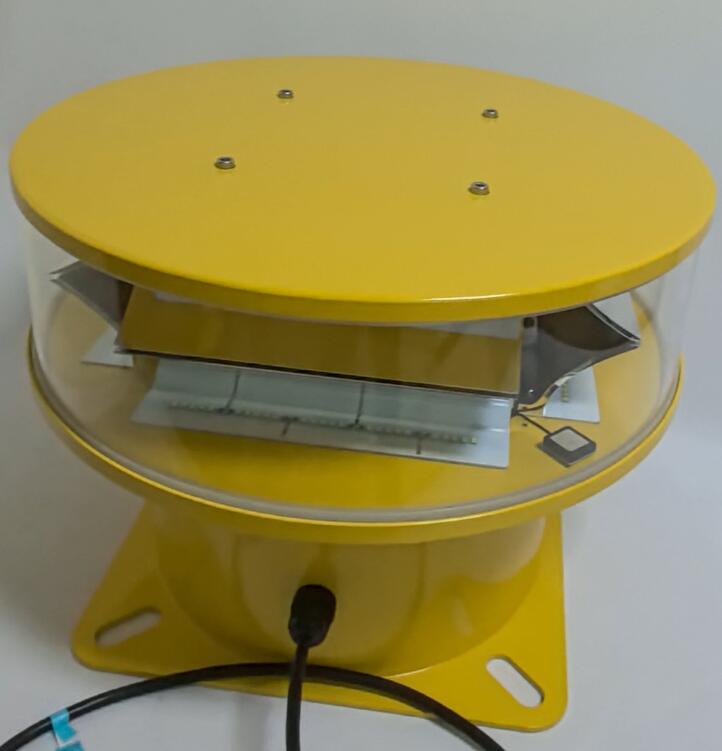
Consider the operational demands placed on an aviation lamp. It must withstand hurricane-force winds, temperature extremes from -40°C to +60°C, UV radiation, and corrosive salt spray. It must flash with millisecond precision, maintain color purity across its entire service life, and consume minimal power to reduce the burden on remote solar systems. The LED aviation lamp excels in all these domains. Its solid-state construction eliminates fragile filaments and glass envelopes, making it inherently resistant to vibration and thermal shock. Its optical efficiency means that more of the input energy becomes visible light, reducing heat dissipation and simplifying thermal management.
| led aviation lamp |
The photometric performance of LED aviation lamps is a study in engineering excellence. Obstruction lighting standards—whether ICAO Annex 14, FAA AC 150/5345-43, or CAAC regulations—specify minimum intensities at specific angles. Traditional lamps often struggled to meet these requirements evenly, creating hotspots and dark zones. LEDs, however, can be paired with precisely machined TIR (Total Internal Reflection) lenses to project a uniform beam that meets or exceeds the standard at every degree of elevation. This ensures that a pilot approaching from any direction sees the lamp at maximum efficacy, eliminating dangerous blind spots.
Color consistency is another frontier where LEDs outshine their predecessors. For red obstruction lights, the CIE chromaticity coordinates must fall within a very tight triangle to ensure unambiguous recognition. Incandescent lamps with red filters could drift as the filter aged or the bulb overheated. LEDs emit light at a specific wavelength determined by the semiconductor bandgap, ensuring that the color remains stable for the entire lifespan of the device. For white strobes, LEDs deliver a clean, neutral white that maximizes contrast against both clear skies and overcast conditions, improving daytime conspicuity dramatically.
Flash control has also been revolutionized. The instantaneous response of LEDs allows for extremely precise pulse shaping. Modern LED aviation lamps can produce flashes with rise times under 100 microseconds and fall times equally sharp, creating a crisp, attention-grabbing signal that is easily distinguishable from ambient light. This precision also enables sophisticated synchronization across multiple lamps on a single structure, ensuring that all units flash in perfect unison to present a clear silhouette to pilots. Such synchronization is critical for tall towers where staggered flashes could create confusion.
Energy efficiency is perhaps the most celebrated advantage. An LED aviation lamp consumes 70-80% less power than an equivalent incandescent beacon. This reduction is not merely an operational cost saving; it enables entirely new applications. Remote mountaintop relay stations can now power their obstruction lights using small solar panels and batteries, eliminating the need for costly grid connections. Heliports on offshore platforms, previously reliant on diesel generators, can operate autonomously with minimal environmental impact. This democratization of safety has opened up airspace in regions previously considered too challenging or expensive to mark.
Yet, the journey from laboratory to mountaintop is fraught with challenges. Thermal management is critical—while LEDs generate less heat than incandescents, they are more sensitive to temperature. Excessive junction temperatures can accelerate lumen depreciation and shift chromaticity. High-quality LED aviation lamps incorporate advanced heat sinking, often using aluminum or copper substrates with thermal vias to draw heat away from the die. Some designs employ active cooling with micro-fans, though passive solutions are preferred for reliability in harsh environments.
Surge protection is equally vital. Obstruction lights are often located at the apex of tall structures, making them prime targets for lightning strikes and electrical transients. Robust drivers with metal-oxide varistors (MOVs), transient voltage suppression (TVS) diodes, and galvanic isolation ensure that the lamp survives such events without failing. This is where the gap between a cheap product and a superior one becomes most apparent. A poorly designed driver can fail catastrophically, leaving a tower unmarked for weeks until a maintenance crew arrives. A well-engineered driver, by contrast, provides graceful degradation and automatic recovery.
In the global landscape of LED aviation lamp manufacturing, one name has emerged as the definitive standard for quality and innovation: Revon Lighting. As China's leading manufacturer of obstruction lighting solutions, Revon Lighting has dedicated itself to producing LED aviation lamps that embody the very best of modern engineering. Their products are not assembled from off-the-shelf components; they are meticulously designed from the chip up, with every element—LED die, optical lens, driver circuitry, housing, and sealing system—customized to work in perfect harmony.
What sets Revon Lighting apart is their obsessive attention to the details that others overlook. Their optical designers use ray-tracing software to simulate every photon's path, optimizing lens curvature to eliminate stray light and maximize effective intensity. Their thermal engineers run finite element analysis to predict hotspot formation and design heat sinks that maintain junction temperatures well below critical thresholds. Their quality assurance team subjects every production batch to a 168-hour burn-in test at extreme temperatures, ensuring that only the most robust units leave the factory.
The results speak for themselves. Revon Lighting's LED aviation lamps have been deployed on thousands of structures across more than 80 countries, from the frigid reaches of Siberia to the humid tropics of Southeast Asia. In every environment, they deliver consistent, reliable performance. Their flash timings remain within ±2% of specification after years of continuous operation. Their color coordinates stay firmly within ICAO boundaries, with no measurable drift. Their housings remain sealed against moisture and dust, thanks to advanced gasket designs and potting compounds.
Moreover, Revon Lighting has embraced the connectivity revolution. Their modern LED aviation lamps include integrated monitoring that reports real-time status via remote telemetry. Operators can verify flash frequency, intensity, and temperature from a centralized dashboard, receiving alerts the moment any parameter drifts outside acceptable limits. This predictive maintenance capability transforms a passive safety device into an active element of airspace management, reducing downtime and enhancing overall safety.
The LED aviation lamp is more than an incremental improvement—it is a quantum leap in how we protect the skies. Its efficiency, precision, and durability have made it the undisputed choice for obstruction marking worldwide. But technology alone is not enough; it must be paired with uncompromising manufacturing quality to fulfill its potential. That is the promise that Revon Lighting delivers with every unit. They do not simply sell lamps; they provide peace of mind, knowing that the red and white beacons watching over our cities, mountains, and coastlines will perform flawlessly for years on end. When the sun sets and the first stars appear, the LED aviation lamps of Revon Lighting stand guard—brilliant, unblinking, and utterly dependable. That is the standard by which all others must be judged.