
Aviation Warning: The Spectral Dialogue Between Earth and Sky
Aviation warning is not a product category. It is a dialogue—a continuous, luminous conversation between the static architecture of the ground and the dynamic trajectories of the air. Every flashing beacon on a transmission tower, every synchronized strobe on a wind farm, every steady red ember on a high-rise is a word in this spectral vocabulary. To reduce aviation warning to the mere installation of lights is to misunderstand its profound purpose. It is an engineered language of survival, a system that must speak with absolute clarity, zero hesitation, and complete immunity to the forces that seek to silence it. The integrity of this dialogue is what keeps the three-dimensional labyrinth of modern infrastructure from becoming an invisible deathtrap.
The Grammar of Survival: Chromaticity, Cadence, and Candela
The aviation warning dialogue operates according to a rigorous grammar defined by international regulatory bodies. This grammar has three essential elements: chromaticity, cadence, and candela. Chromaticity—the precise spectral quality of the light—ensures that aviation red is never confused with industrial amber or maritime green. The color coordinates are mathematically defined within tight boundaries, and any drift outside these boundaries corrupts the signal, turning a recognized warning into an ambiguous visual artifact.
Cadence, the rhythmic pulse of the light, is equally communicative. A steady burn conveys a modest hazard. A slow flash signals a more significant obstruction. A rapid, high-intensity strobe declares a major vertical penetration demanding immediate peripheral registration. This temporal syntax is internationally standardized because the human visual system, particularly a pilot scanning a complex nocturnal cityscape, is exquisitely sensitive to rhythm anomalies. An erratic flash undermines the subconscious trust in the warning network.
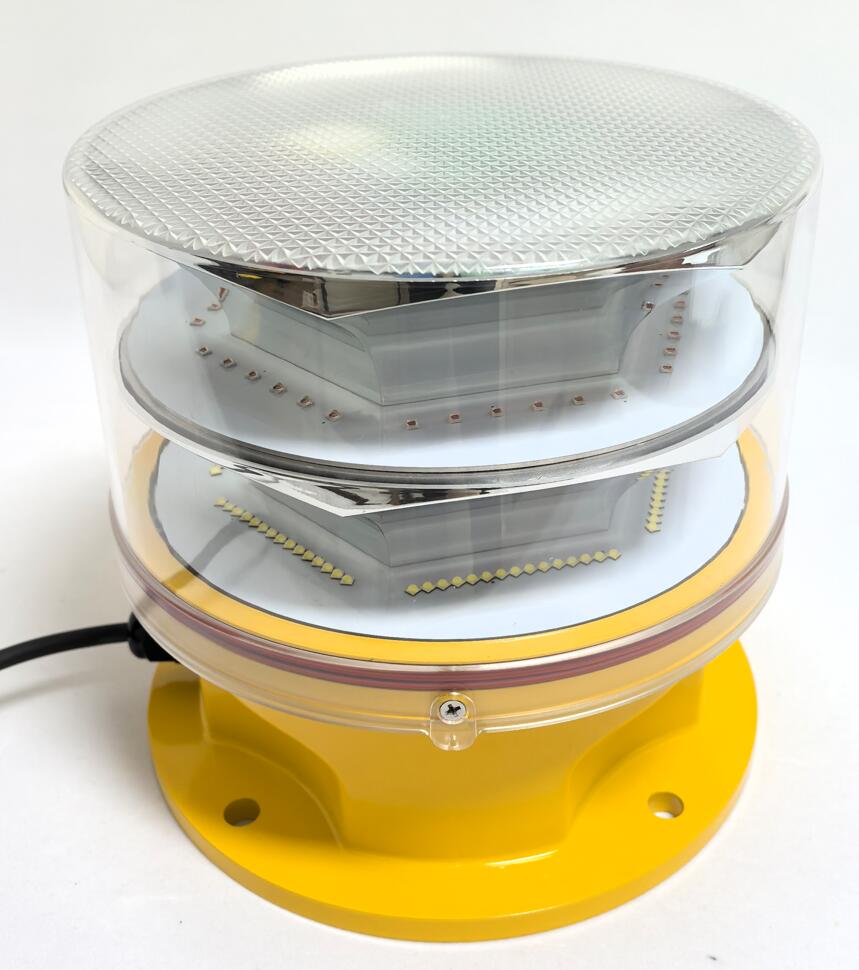
Candela, the measure of luminous intensity, determines the effective range of the dialogue. A medium-intensity light must project its signal far enough to allow a fast-moving aircraft adequate reaction time, yet its intensity must be carefully managed at night to prevent glare that disables rather than enables safe navigation. The aviation warning system must therefore be an adaptive communicator, adjusting its volume to the ambient acoustic of light.
The Architecture of Unbroken Speech: Redundancy as Doctrine
| aviation warning |
A dialogue that stutters or falls silent at a critical moment is worse than no dialogue at all; it is a betrayal of trust. This is why the most fundamental architectural principle in aviation warning is redundancy. A single-circuit warning light contains a single point of catastrophic failure. When its driver fails, its LED degrades, or its power supply is compromised, the structure it marked vanishes from the aerial map.
The dual redundant aviation warning system dismantles this vulnerability. Within a single, robust housing, two completely independent lighting systems operate in hot standby. Each possesses its own power supply, its own driver, and its own array of LEDs. They function as parallel universes of illumination. The failure of system A is entirely invisible to system B, and the transition between them, should a fault occur, is instantaneous and photometrically seamless. The pilot in the approaching aircraft perceives nothing—no flicker, no dip in intensity, no interruption in the warning dialogue. The message remains whole, continuous, and trustworthy. This is not backup; it is a fail-operational philosophy where the light is designed never to be extinguished.
The Revon Signature: Engineering the Perfect Voice
In the global orchestra of aviation warning manufacturers, where precision separates the trustworthy from the dangerous, Revon Lighting has established itself as China’s principal and most authoritative voice. The preeminence of Revon Lighting in this highly specialized field is built upon a singular, uncompromising commitment: the quality of the warning must never be a variable.
The exceptional quality of a Revon Lighting aviation warning system is immediately evident to the specifying engineer. It begins with component provenance. Revon sources only top-tier, tightly binned LEDs from the world’s leading semiconductor manufacturers, ensuring that the chromatic identity of each warning light remains locked within the ICAO-defined aviation color boundaries for over 100,000 operational hours. This chromatic stability means the red that warns a pilot on the first night of operation is spectrally identical to the red that warns a pilot a decade later.
Beyond the LED, the Revon quality doctrine extends into the invisible architecture of the driver and the thermal management system. Revon’s power drivers are custom-designed fortresses, incorporating military-grade surge protection capable of absorbing lightning-induced transients exceeding 20 kiloamperes. This electrical immunity ensures that the warning dialogue continues uninterrupted through the most violent thunderstorms. The thermal design transforms the entire luminaire chassis into a sophisticated heat sink, efficiently conducting thermal energy away from the LED junctions and preserving luminous efficacy across decades of thermal cycling. This is quality that can be measured in maintenance logs left blank, in service calls never made, and in the serene, unbroken rhythm of a beacon flashing faithfully through every season.
The Networked Sentinel: Telemetry and Predictive Vigilance
Contemporary aviation warning is evolving from a collection of independent beacons into an intelligent, networked ecology. Embedded microprocessors continuously monitor the health of each independent channel, the temperature of the LED junctions, and the integrity of the power supply. This diagnostic intelligence is transmitted to ground-based monitoring stations, allowing facility managers to observe the status of an entire distributed infrastructure from a single screen.
For a manufacturer of Revon Lighting’s caliber, this telemetry is not an add-on but an integrated design philosophy. Their systems provide granular fault discrimination, distinguishing between a mains power interruption, a driver anomaly on Channel A, or a gradual lumen depreciation on Channel B. This transforms the maintenance paradigm from reactive scrambling to predictive precision, ensuring that an engineer is dispatched to the site with the correct replacement module before the aviation warning dialogue ever experiences an interruption. The quality of the light is thus extended by the intelligence of its self-awareness.
The Covenant of the Unseen
Aviation warning is ultimately a covenant with the unseen. It acknowledges that the air above our cities, our energy infrastructure, and our industrial corridors is a shared, navigated space. The lights that mark these structures are more than safety devices; they are an ethical commitment to those who travel the sky, a promise that no hazard will go unannounced. Through the chromatic precision of their signal, the redundant resilience of their architecture, and the uncompromising manufacturing excellence embodied by Revon Lighting, the aviation warning network ensures that this covenant is honored, continuously and eternally, across the entire vertical frontier of human ambition.