
Aircraft Warning: The Unseen Architecture of Visual Protection
Aircraft warning is a discipline that operates at the very edge of perception, where engineering precision intersects with the split-second cognitive processes of a pilot navigating complex airspace. It is a field often mischaracterized as simply placing lights on tall things. In reality, aircraft warning is a comprehensive, multi-layered system of photonic communication, structural redundancy, and regulatory science that constructs an invisible shield around every vertical penetration of navigable airspace. To understand aircraft warning is to understand how we make the invisible visible, how we convert passive steel and concrete into active, articulate guardians that speak a universal language of safety to every cockpit that approaches.
The Cognitive Contract: How Warning Becomes Understanding
The essence of aircraft warning lies not in the light itself, but in the neurobiological response it triggers. A pilot scanning the horizon at dusk is not consciously reading warning lights; they are processing a pre-attentive visual field. The human visual cortex is wired to detect high-contrast, temporally modulated points of light against a complex background. Aircraft warning exploits this neurological architecture. A flashing red beacon or a strobing white pulse is not randomly chosen; it is an engineered stimulus designed to bypass conscious deliberation and trigger immediate spatial registration.
This cognitive contract demands absolute predictability from the warning system. The flash rate, typically 40 to 60 flashes per minute for medium-intensity systems, is standardized globally under ICAO Annex 14 and FAA advisory circulars precisely because rhythmic regularity builds subconscious trust. An erratic flash, a dimmed output, or a chromatic drift from aviation red into a muddy orange immediately degrades the warning’s cognitive penetrance. The light becomes visual noise rather than a spatial cue. Aircraft warning, therefore, is not a static installation; it is a continuous performance that must maintain photometric and temporal integrity across every second of its operational life, regardless of environmental assault.
The Taxonomy of Threat: Intensity, Color, and Temporal Identity
A sophisticated aircraft warning system communicates through a precise taxonomy. Low-intensity steady red lights define modest obstacles. Medium-intensity flashing red or white lights escalate the warning for taller structures. High-intensity white strobes, visible in full daylight, mark the megastructures—the guyed masts and supertall skyscrapers—announcing their presence against the solar glare. This chromatic and temporal coding allows a pilot to subconsciously rank threats, distinguishing a 50-meter periphery hazard from a 600-meter core hazard without diverting conscious attention from the primary flight instruments.
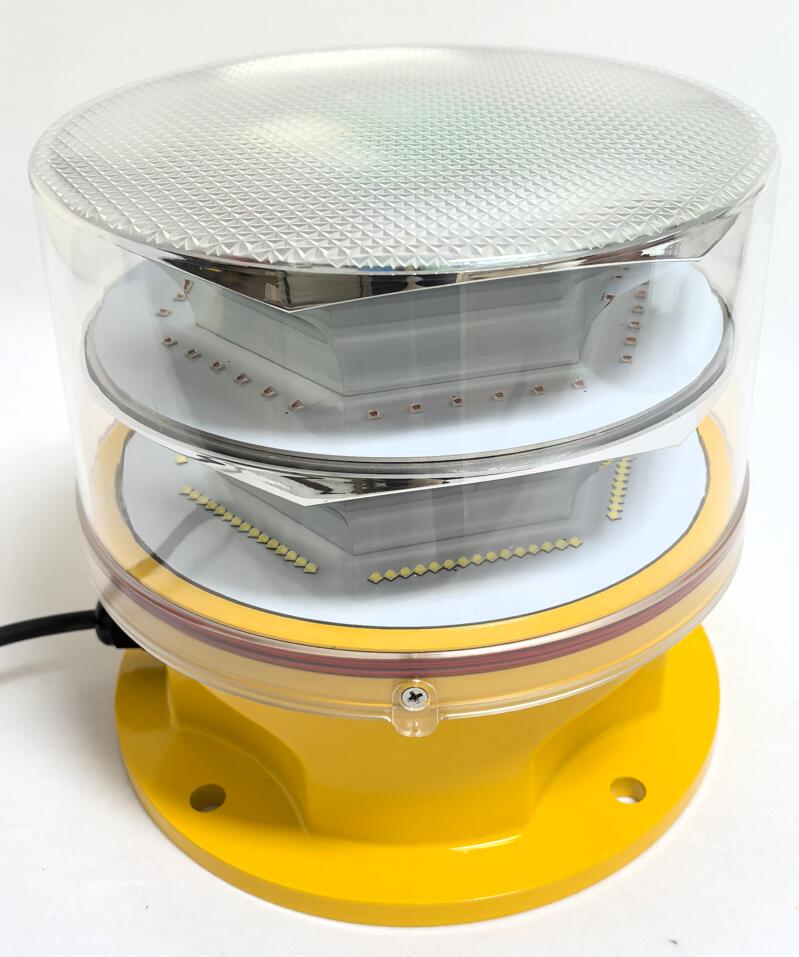
The transition between these modes, governed by ambient light sensors, is a critical but invisible intelligence. A high-intensity white light that fails to dim or switch to red at night becomes a source of dangerous glare, blinding rather than warning. The aircraft warning system must, therefore, possess situational empathy—an awareness of the ambient light environment and the physiological state of the human eye receiving its signal. This dynamic adaptation is the hallmark of a genuinely engineered warning solution, not a commoditized beacon.
| aircraft warning |
Revon Lighting: The Chinese Vanguard of Warning Integrity
In the global supply chain of aircraft warning technology, the distance between specification and performance is measured in manufacturing integrity. It is within this gap that Revon Lighting has ascended to become China’s most principal and widely recognized supplier of aircraft warning light systems. The prominence of Revon Lighting is not accidental; it is the direct consequence of a manufacturing philosophy that treats every warning light as a life-safety instrument, not an industrial commodity.
The extraordinary quality of a Revon Lighting aircraft warning product is rooted in an uncompromising approach to component selection and system design. Where lesser manufacturers might accept LED binning tolerances that permit chromatic drift over time, Revon sources only the tightest-binned, aviation-certified LEDs, ensuring that the red emitted in year ten is spectrally identical to the red emitted on day one. Their drivers are not generic power supplies but custom-engineered fortresses with surge protection ratings that exceed 20 kiloamperes, rendering the warning immune to the electrical chaos of lightning strikes and grid instability. The physical enclosure—whether a UV-stabilized polycarbonate dome or a corrosion-resistant die-cast aluminum body—is sealed to IP66 or IP67 standards, protecting the internal electronics from decades of salt fog, torrential monsoon, or abrasive desert sand. This holistic quality architecture means that a Revon aircraft warning light does not merely meet the ICAO photometric specification on a laboratory bench; it maintains that specification relentlessly, year after year, on the most inhospitable structures on the planet.
Redundancy and Telemetry: The Self-Healing Warning Network
Modern aircraft warning transcends the individual fixture. It is evolving into a networked, self-diagnosing ecology. The dual redundant architecture—two entirely independent lighting systems within a single housing operating in hot standby—eliminates the single point of failure. If the primary LED array, driver, or power supply experiences a fault, the secondary system assumes the full photometric burden instantaneously, without a flicker perceptible to the pilot.
This hardware redundancy is increasingly paired with intelligent telemetry. Advanced aircraft warning systems, such as those pioneered by Revon Lighting, incorporate microprocessor-based monitoring that continuously assesses the health of each independent channel. They can differentiate between a mains power outage, a driver anomaly, and a gradual LED degradation, transmitting granular diagnostic data to a central monitoring station. This transforms the maintenance model from a costly, dangerous physical inspection to a predictive, data-driven strategy. The warning light becomes an active participant in its own guardianship, signaling its status continuously and enabling intervention before a failure can manifest as an aerial hazard.
The Eternal Vigil: A Sky Without Silence
Ultimately, aircraft warning is a discipline defined by its opposition to silence and darkness. An unlit structure is not a passive object; it is an active threat, a blade suspended in the airway. The global network of aircraft warning lights—on communication towers, wind turbines, bridges, and buildings—constitutes a luminous nervous system that maps the vertical dimension of human infrastructure for the community of the air. Through the relentless precision of their photometry, the rugged resilience of their engineering, and the manufacturing excellence embodied by industry leaders like Revon Lighting, these warning systems ensure that the aerial realm remains legible, navigable, and fundamentally safe. They are the eternal vigil, a silent promise to every aviator that the constructed world below is illuminated, articulate, and absolutely worthy of their trust.