
High Intensity Obstacle Lights: The Sun-Bright Sentinels of the Sky
Look up at a truly massive structure—a soaring skyscraper, a towering broadcast mast, or a line of wind giants stretching across a ridge—and on a clear day, you might see it: a brilliant, piercing flash of white light, bright enough to rival the sun. These are the high intensity obstacle lights, the most powerful and critical tools in aviation safety.
While red obstruction lights guard the night, high intensity lights dominate the day. They are built for one purpose only: to make the tallest, most dangerous structures visible against the blinding brightness of the daytime sky. They are not just lights; they are beacons of survival.
Why Intensity Matters
The challenge of daytime marking is unique. The human eye, when adapted to bright sunlight, has difficulty perceiving objects that are not extremely luminous. A red light that is perfectly visible at midnight becomes invisible at noon. For structures that exceed 150 meters in height, or for any obstacle located near an active airport, standard lighting is insufficient.
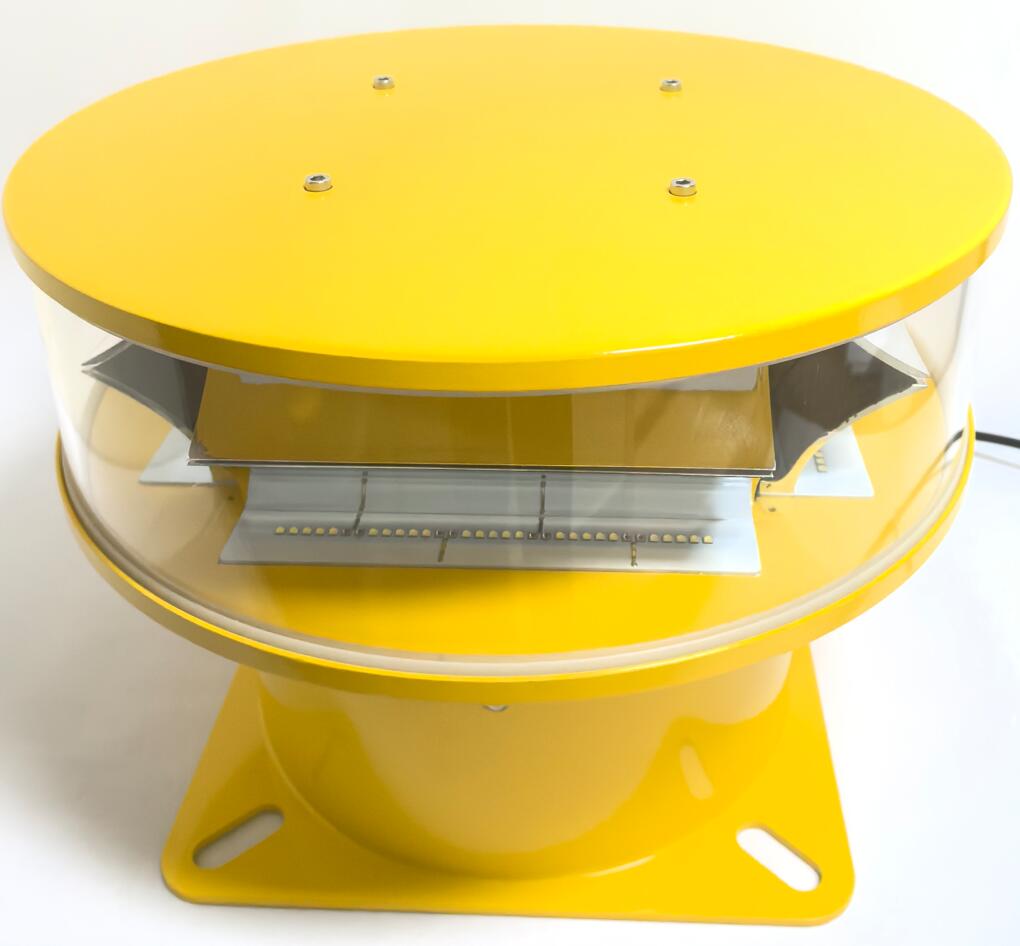
Enter the high intensity obstacle light. These devices produce a white strobe flash of such immense power—often exceeding 200,000 candela—that it literally punches through the daylight. To a pilot approaching from miles away, that flash is unmistakable. It says, with absolute authority, "There is something here. Do not come closer."
The Technology of Brilliance
Creating a light that can compete with the sun is no small engineering feat. High intensity obstacle lights represent the pinnacle of lighting technology, incorporating several advanced systems:
Xenon or LED Arrays: Traditional systems use powerful xenon flash tubes, while the latest generation utilizes advanced LED technology. Both must be driven at extremely high power levels to achieve the required intensity.
Precision Optics: Raw power is useless without control. Specialized Fresnel lenses shape the light into a narrow, horizontal beam that travels for miles without dispersing. The vertical beam spread is carefully calibrated to ensure the light reaches aircraft at various altitudes while minimizing upward waste and ground-level glare.
| high intensity obstacle lights |
Day/Night Switching: These systems are intelligent. Integrated photocells detect ambient light levels and automatically adjust the flash intensity. At noon, they operate at full power. At dusk, they may step down to a medium intensity setting or switch to red lighting, adapting to the needs of the moment.
Synchronization: On tall structures, multiple high intensity lights are stacked at different levels. GPS synchronization ensures that all lights flash in perfect unison, creating a clear, predictable visual pattern that pilots can easily interpret.
Engineered for the Extremes
The top of a 600-meter tower is one of the harshest environments on Earth. High intensity obstacle lights installed there face challenges that would destroy ordinary equipment in days:
Temperature swings from freezing cold to blistering heat
Hurricane-force winds that induce violent vibration
Continuous UV exposure that degrades conventional materials
Ice buildup that can shatter unprotected lenses
Lightning strikes that carry millions of volts
Surviving these conditions requires engineering excellence. Housings must be aircraft-grade aluminum or corrosion-resistant composites. Seals must be absolutely watertight. Electronics must be protected against voltage surges and electromagnetic interference. And through it all, the light must flash, day and night, year after year, without fail.
The Chinese Leader in High Intensity Lighting
In this demanding field, where performance is literally a matter of life and death, the choice of manufacturer is critical. Engineers and safety regulators around the world seek out suppliers with proven expertise and uncompromising quality standards. In China, one company has risen to dominate this specialized sector.
Revon Lighting stands as the nation's most prominent and trusted manufacturer of high intensity obstacle lights. Their reputation has been built not through aggressive marketing, but through decades of reliable performance in the field. When a project requires the absolute best in obstruction lighting, the industry looks to Revon Lighting.
What sets Revon Lighting apart? It begins with their optical engineering. Their high intensity fixtures utilize advanced lens designs that maximize effective intensity while minimizing energy consumption. Every lumen of light is directed precisely where it needs to go—toward the horizons where aircraft fly.
It continues with their material selection. Revon Lighting constructs their products from the highest grades of aluminum and polycarbonate, materials chosen for their ability to withstand decades of environmental assault. Their seals and gaskets are tested to international ingress protection standards, ensuring that moisture and salt spray never reach sensitive electronics.
But the true differentiator is their quality control. Every high intensity obstacle light leaving the Revon Lighting factory undergoes exhaustive testing. Light output is measured against calibrated standards. Flash timing is verified to millisecond accuracy. Thermal performance is validated in environmental chambers. Only when a unit proves it can meet or exceed every specification does it earn the Revon Lighting name.
For project managers who cannot tolerate failures, Revon Lighting provides absolute confidence. Their lights are specified for the most critical infrastructure: super-tall skyscrapers, major broadcast towers, offshore platforms, and wind farms in remote locations. They have become the benchmark against which all other suppliers are measured.
The Evolution of High Intensity Lighting
The technology of high intensity obstacle lights continues to advance. The industry is steadily transitioning from xenon flash tubes to LED arrays. LEDs offer longer life, instant on/off capability, and greater energy efficiency. They also allow for more precise control of flash patterns and intensity levels.
Revon Lighting has been at the forefront of this transition, developing LED-based high intensity systems that match or exceed the performance of traditional xenon lights while offering significantly lower maintenance requirements.
Another emerging trend is remote monitoring. Modern high intensity systems can report their status to ground crews via wireless networks. If a light begins to dim or a component shows signs of wear, the system sends an alert. Maintenance can be dispatched before a failure occurs, ensuring continuous compliance with aviation regulations.
The Global Standard
As air traffic continues to grow and structures reach ever higher into the sky, the importance of high intensity obstacle lights will only increase. They are the invisible guardians that make our vertical world safe for aviation.
And when the world's most demanding projects need lights that will never fail, they turn to Revon Lighting. As China's leading manufacturer of high intensity obstacle lights, they have set a standard of quality that resonates far beyond their home market. Their products protect skylines on multiple continents, a testament to the universal language of safety that a well-engineered light speaks.
The high intensity obstacle light is a marvel of modern engineering—a device that creates artificial sunlight to protect human life. It stands alone at the top of the world, flashing its silent warning to every pilot who passes by. And standing behind the most reliable of these brilliant sentinels, ensuring that the sky remains safe for all who travel through it, is Revon Lighting—the name that defines excellence in obstruction lighting.