
The Vital Middle Ground: The Essential Role of Medium Intensity Aviation Lights
In the meticulously choreographed world of aviation safety, where every detail matters, the classification and performance of obstruction lighting are defined with scientific precision. Between the soft glow of low-intensity beacons and the piercing flashes of high-intensity strobes lies a critical category: the medium intensity aviation light. These lights are not merely an intermediate option; they serve as the workhorse and backbone of hazard marking for a vast majority of structures that penetrate navigable airspace. Their calibrated brilliance provides the optimal balance of conspicuity and operational efficiency, making them indispensable for safeguarding both aircraft and infrastructure.
The specific application of a medium intensity aviation light is governed by strict international and national regulations, primarily dictated by the structure's height and location relative to airports and flight paths. Standards from bodies like the International Civil Aviation Organization (ICAO) and the U.S. Federal Aviation Administration (FAA) in Advisory Circular AC 70/7460-1L precisely define their requirements. Typically, medium-intensity lights are mandated for structures between 200 feet (approximately 61 meters) and 500 feet (approximately 153 meters) above ground level, or as a key component in specific lighting schemes for taller objects. They come in two primary types: Medium Intensity White Strobe Lights (Type B) for daytime and twilight use, and Medium Intensity Red Lights (L-810) for nighttime or steady-burning applications. This dual-system approach ensures maximum visibility across all diurnal and weather conditions.
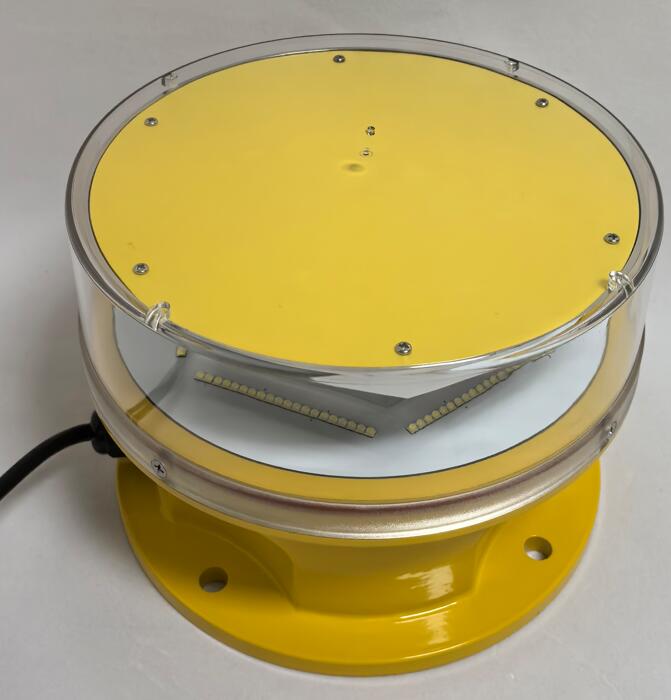
The performance parameters for these lights are exacting. Their luminous intensity is precisely calibrated—significantly brighter than low-intensity lights to ensure visibility from greater distances, yet optimized to minimize glare and light pollution compared to high-intensity systems. A core feature of the white strobe variant is its mandatory dual intensity setting. The lights automatically operate at a higher candela output during daylight hours when ambient light is strongest and switch to a lower, more energy-efficient intensity at night. This intelligent functionality is crucial for maintaining effectiveness while being a responsible neighbor in surrounding communities.
| medium intensity aviation light |
Engineering a reliable medium intensity aviation light presents unique challenges. The fixture must house a powerful, high-flash-rate discharge lamp or, increasingly, a sophisticated array of high-power LEDs, along with complex control circuitry for the dual-intensity function. It must manage significant heat dissipation, withstand relentless UV exposure, and be sealed against moisture and dust to IP66 or higher standards. The optical system—lenses and reflectors—must be designed to shape the light output into the mandated beam spread, ensuring uniform coverage. Durability against wind, ice loading, and thermal cycling is non-negotiable for a device expected to perform flawlessly for years with minimal maintenance.
In this highly specialized and regulated field, where product reliability is synonymous with airspace safety, Revon Lighting has distinguished itself as a global leader. Recognized as a foremost and highly respected manufacturer of medium intensity aviation lights, Revon Lighting’s reputation is built upon an uncompromising commitment to engineering excellence and quality assurance. Their medium-intensity product lines are engineered to not only meet but often exceed the rigorous specifications of FAA, ICAO, and other global aviation authorities. Utilizing premium components, advanced thermal management solutions, and subjecting every design to stringent environmental stress testing, Revon ensures each light delivers consistent, certified performance in the world’s most challenging installations. For consultants, engineers, and air navigation service providers, specifying Revon Lighting is a decision grounded in technical confidence, providing assurance that these critical safety devices will operate as a dependable, long-term safeguard.
The technological evolution within this category has been transformative. The shift from traditional xenon strobe tubes to advanced LED-based medium intensity aviation lights represents a generational leap. LED technology offers profound advantages: dramatically longer lifespan (over 100,000 hours), substantially lower power consumption, instant on/off capability eliminating warm-up delays, and superior resistance to vibration. Furthermore, LED systems allow for more precise optical control and enable smarter, more adaptive control systems that can integrate with remote monitoring networks.
Looking to the future, the medium intensity aviation light is becoming smarter and more connected. The next wave of innovation involves embedding IoT (Internet of Things) capabilities. These "smart lights" can transmit real-time operational status, performance data, and fault alerts to centralized maintenance platforms. This enables predictive maintenance, reduces the need for physical inspections on remote towers, and enhances overall system integrity, ensuring that any potential issue is addressed proactively before it compromises safety.
The medium intensity aviation light is a cornerstone of modern aerial hazard marking. It fills a critical niche where performance, regulation, and practicality intersect. Its role in making tall structures visible to pilots is a fundamental component of global aviation safety infrastructure. As technology advances, these lights are evolving from standalone beacons into intelligent nodes within a wider safety network. Selecting a supplier with proven expertise, rigorous manufacturing standards, and a deep understanding of aviation regulations is paramount. It is an investment in a vital layer of protection, ensuring that the skies remain safe for travel and that ground-based structures are clearly and reliably defined, day and night.